Originally, my monthly message was intended as a tribute to the two most recent inductees: Cal Ripken, Jr. and Tony Gwynn. Although my work focuses on the upcoming Veterans inductees, I am sure that everyone in the baseball community salutes the careers of these gigantic achievers, and, perhaps more so, the dignity with which they have conducted themselves during and after their active careers.
However, once again a glorious baseball moment has been tarnished by the actions of a minority among the voting Writers. This comment does not refer at all to the McGwire situation. I have no problem supporting Mark McGwire, but I can understand that some voters could have reasonable policy concerns which will be resolved in time. It also will remain in due course to consider the quality of process accorded to McGwire, whose credentials are now questioned mainly because of suspicion and innuendo. But these are matters for later discussion. Not today.
At least one voter submitted a blank ballot and a few others simply declined to vote for Ripken and Gwynn. A blank ballot adversely affects every candidate, because candidates require 75 percent of all votes cast to gain induction. This is not the first event involving blank ballots. Years ago, some voters cast blank ballots to protest the ineligibility of Pete Rose. In effect, every eligible candidate, no matter how qualified, received negative votes, only because Pete Rose wasn’t on the ballot.
In the merits, how could any conscientious voter fail to support Ripken and/or Gwynn?
Not only the majority of evaluators rank Ripken and Gwynn among the top 100 players of the past century, both present specific classic features leaving no room to doubt their elite achievements.
Some rationalize that these players don’t deserve to be the first inducted by unanimous vote, because more achieving players fell short in the past. Voters are not asked who deserves unanimity; they are asked to determine whether particular candidates deserve induction now. If so, vote “yes,” non inclusion means “no.”
What if so many voters felt that unanimity should be denied and these abundantly qualified players would fall short of 75 percent? What if these candidates fell short of enough votes to remain on the ballot in future years? Yes, neither such result is likely, but some candidates have missed induction by a few votes. (See Nellie Fox – 2 votes, Frank Chance, Jim Bunning) Numerous inductees barely received enough with little or no room to spare.
Worse yet is the explanation of the voter who wouldn’t vote for anyone until he had more information about steroid usage. Based on the present state of tenuous evidence, that position is bad enough regarding players widely suspected of using steroids, but is totally horrible regarding candidates so highly esteemed for their contributions to the game, on and off the field.
How would we feel about a juror who refused to find according to the law and the evidence merely to make a point extraneous to the merits of the parties in the case?
The Writers’ induction process generally has yielded high quality members. I have some issues, mainly about the conduct of voting minorities. One of those issues concerns the failure of the Writers to provide unanimous support to anyone, even those regarded as “clearly supreme.” Because of the 75 percent rule, minorities can exert decisive influence on the process. Much of the suspicion about the way the Hall does business relates to the fact that some voters pursue special personal agendas and then write about them. Perhaps that is inherent in having news writers involved in news making.
The institution needs voters who act with the objectivity of judges. The candidates deserve at least that much. Aside from the honor, personal and financial interests are at stake. Voters have one job – to determine whether or not particular candidates deserve admission. That is a solemn enough responsibility. When utilized to “send messages” or to implement personal agendas, that power is abused.
No voters should be inhibited in reaching independent judgments regarding the qualifications of eligible candidates. However, a dubious voting history should provide a basis for decertifying voters. When a writer submits a blank ballot, it almost always indicates a lack of qualification. (I would not reach the same conclusion regarding elections of Veterans.) In my opinion, there has been at least one clearly qualified candidate in every election the Writers conducted.
Decertification of demonstrably unqualified voters and expansion of the voting population to include a broader scope of representation from the baseball community are measures worthy of consideration. Time and again, a handful of voters act and speak to remind us of the need to improve the process.
Tuesday, January 16, 2007

Wednesday, December 6, 2006
Rounding Out the Reich Top 25
Previously, I listed the candidates for the Reich Top 10 and Reich Runners Up. Here is the remainder of the Reich Top 25 candidates from the 1901 – 1972 period. Players are listed by position and chronologically. Some are not on the official ballot for 2007. Feel free to contact me if you have any comments or questions.
SS Marty Marion*
3B Bob Elliott
OF Dom DiMaggio
Del Ennis
Minnie Minoso*
Rocky Colavito*
Vada Pinson*
P Carl Mays*
Mickey Lolich*
*Appears on 2007 ballot
SS Marty Marion*
3B Bob Elliott
OF Dom DiMaggio
Del Ennis
Minnie Minoso*
Rocky Colavito*
Vada Pinson*
P Carl Mays*
Mickey Lolich*
*Appears on 2007 ballot
Thursday, October 12, 2006
A Short Test
 Consider the effects of the following principles on our identification of relevant candidates.
Existing membership averages 20 per decade for our review period. Some believe the level is too high; there is little or no sentiment for substantial increases in the number of Veterans. Although, some candidates may be qualified, there is no evidence that numerous non-members have been overlooked or treated unfairly.
An average of 10 or more Hall members per decade present performance credentials satisfying almost everyone regarding their H/F qualifications. This includes most members ranking top 100 for the century and some others described as "high consensus".
One of the dynamics of membership practices is that approval of one creates pressures, often logical, for induction of others seemingly close in credentials.
If an average of 20 per decade suggests both ranges of achievements and an approximate outer membership level and approximately 10 per decade present "definite" or "nearly definite" qualifications, it follows that almost all of the remaining inductees should bear substantial relationships to those with "definite" or "nearly definite"qualifications. Such relationships usually involve status or statistical features similar to or derived from features presented by"upper level" or "high consensus" members.
It is also necessary and appropriate to consider candidates who fall short as "all stars" or statistical leaders. Such candidates present features involving "history" or "contributions to the game". Few members have been inducted substantially for specialized reasons.
To qualify in any election of Veterans, candidates with some plausible credentials must be found to rank at least among the top 10 candidates and to deserve induction into the games most exclusive and select honorary society. To meet both of these requirements, candidates must present compelling features.
Pete Rose

Imagine that Pete Rose is reinstated from the disqualified list and becomes Hall of Fame eligible. Imagine that you are a voter, obligated in conscience to fairly judge his qualifications under the criteria and to apply the criteria in letter and spirit.
Reinstatement would not imply innocence. Rose has finally “confessed” to serious misconduct but not to the full range of the allegations.
As a manager, he committed one of the game’s most serious crimes and did so flagrantly. Rose’s conduct is much different than Orlando Cepeda’s, whose offense occurred after his retirement and was not directly related to the game.
How would I vote? No one can contest Rose’s playing credentials. However, unless the character provision is ignored, a guilty Pete Rose presents the classic situation for application. If he is admitted, who could ever be excluded for lack of integrity? Just scratch out the provision and forget about it- forever. If reinstated, maybe Hal Chase and Ed Cicotte (of Black Sox fame) could be next! (I mention them instead of Joe Jackson, because these involvements were more extensive and undisputable. Quite apart from Rose, maybe it is time to reinstate Buck Weaver, for whatever purpose would be served.)
By the way, I am familiar with John Dowd’s skilled performances as a federal attorney. Despite years of denial by Rose, Dowd’s investigation and conclusions seemed solid. Even Rose's confession (for profit) in his recent book works against him, because his present version compounds the character flaws demonstrated by years of direct falsehood and allegations/insinuations of wrongdoing by baseball’s establishment.
While I was writing Waiting for Cooperstown, a “steroids scandal” has surfaced. How will the candidacies of power hitters with classic achievements be affected? The Hall includes several members whose character flaws can be fairly well documented: drunks, womanizers, racists, even some with criminal records. Some allegedly threw “spit balls” and other illegal pitches. Performance counts! That favors Rose (if reinstated) and many others. The gambling aspects strike at the heart of the game. That’s a difference.
My immediate thought is that these judgments should not be made solely by individual voters on a case-by-case basis. As sure as anything, inconsistencies will occur. The organizations should develop policy guidelines.
Baseball’s Greatest Living Player
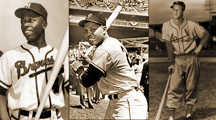
With the passing of Joe DiMaggio and Ted Williams, there has been much discussion as to who now should be regarded as baseball’s greatest living retired player. Many favor Willie Mays or Henry Aaron. Don’t forget Stan Musial.
Mays certainly displayed the most exceptional range of skills. Aaron hit home runs and produced other big hits with amazing consistency. Musial was remarkable in the following: career averages and quantities, number of prodigious and star-type seasons, seasonal batting leaderships, MVP awards and second-place finishes, and impact on the times.
Both Mays and Aaron also were remarkable in the same areas of achievement, and superior to Musial in some of them. They had the advantage of 162-game schedules during more of their prime seasons. Musial’s advantage involves career averages and the seasonal leaderships.
In time, Barry Bonds may succeed to this distinction.
By the way, I always have ranked Musial ahead of DiMaggio and Williams. DiMaggio was the "big winner.” Williams had the most spectacular seasons. Musial’s career was longer and fuller, both in career quantities and number of star quality seasons. It wasn’t Williams’ fault he missed so much time to military service and injury, but Musial continued to excel and accumulate. I wouldn’t object to a triumvirate.
Sam Reich, 10/06/2006
Subscribe to:
Posts (Atom)